Menu

about freedom's frontier

Freedom’s Frontier National Heritage Area is a congressionally designated region shaped by ongoing debates over rights, freedom, and their meaning in American democracy. Past struggles here sparked a firestorm that preceded the Civil War. These struggles continue to the present day as our nation’s concept of “freedom for all” evolves.

Freedom’s Frontier is one of the largest National Heritage Areas in the country, defined both by the geography of its 41 counties—a fabric of rivers, topography, soils, and vegetation across the states of Missouri and Kansas—and by the events that occurred here over the past two centuries. While many other heritage areas are based around physical sites, corridors, or canals, residents decided that Freedom’s Frontier should be story-based. The settings within Freedom’s Frontier provide rich opportunities for residents to tell the area’s unique contributions to the country’s story of freedom, social values, and human rights.

Freedom’s Frontier National Heritage Area (FFNHA) is dedicated to building awareness of the struggles for freedom in western Missouri and eastern Kansas. These diverse, interwoven, and nationally important stories grew from a unique physical and cultural landscape. FFNHA inspires respect for multiple perspectives and empowers residents to preserve and share these stories. We achieve our goals through interpretation, preservation, conservation, and education for all residents and visitors.

We consider places, stories, or landscapes to be nationally significant when they contain important regional and national stories that, together with their associated natural and/or cultural resources, enable the American people to understand, preserve and celebrate key components of the multi-faceted character of the Nation’s heritage. These are our region’s stories:

Shaping the Frontier

For the half million pioneers who traveled on the Santa Fe, California, Mormon, and Oregon Trails, the Missouri/Kansas border was the jumping off point. In this place where river travel ended, traders, miners, and emigrants purchased provisions and prepared for long overland treks. As they traveled west, many began to see the “permanent” Indian frontier beyond Missouri’s western border as an obstacle to Manifest Destiny.

Missouri-Kansas Border War

When Kansas was opened for settlement in 1854, a border war ensued, capturing the nation’s attention. The Kansas-Nebraska Act nullified the uneasy balance established by the Missouri Compromise and left the territory’s future slave status in the hands of settlers. The stakes were high for both sides. The violence of the Missouri/Kansas Border War ushered in the Civil War, consumed the region in bloody conflict through war’s end, and devastated communities on both sides of the border.

The Enduring Struggle for Freedom

The nation’s struggle for freedom did not end with the Civil War. Though the war eliminated clashes over geography, efforts to break down society’s barriers continue. Since the Civil War, this place has inspired national policies and ongoing efforts to secure equal freedoms for all Americans.

  1. Build awareness of the struggles for freedom that took place within the boundaries of Freedom’s Frontier for current and future generations.
  2. Enhance, sustain and preserve the unique cultural and historic assets within our nationally important physical and cultural landscape that fostered these stories.
  3. Inspire tolerance and respect for multiple perspectives.
  4. Preserve and share our nationally important authentic stories in an engaging way.
  1. We will be tolerant and respectful of diverse stories from multiple perspectives.
  2. We will respect property rights.
  3. We will focus on authentic and engaging experiences.
  4. We will honor the region’s peoples, past and present.
  5. We will appreciate unique cultural and historical assets within the nationally important landscape.
  6. We will invest in community engagement, education and empowerment.
  7. We will sustain and grow a sense of place.
  8. We will value and protect the natural environment.
  9. We will consider future generations in everything we do.

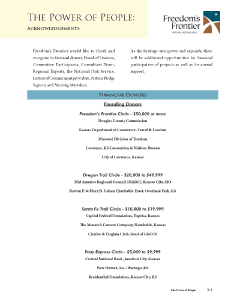
Enabling legislation authorizes basic operating funds. These federal funds must be matched 1:1 by local dollars. FFNHA has received funding from the following private and public foundations, governments and private individuals to match federal dollars and support this work: City of Lawrence, KS; Douglas County KS Board of Commissioners; Lawrence, KS Convention & Visitors Bureau; Missouri Division of Tourism; Kansas Department of Wildlife, Parks & Tourism; Barton P. and Mary D. Cohen Charitable Trust, William T. Kemper Foundation, Monarch Cement Company (Humboldt, KS); Mid-America Regional Council (MARC); Capitol Federal Foundation; South East Kansas Prosperity Foundation; Kansas Humanities Council; Charles & Virginia Clark Fund of the Greater Kansas City Community Foundation; Kansas Health Foundation, Breidenthal Foundation, KCK; New Dymax, Inc., Wamego, KS; Central National Bank, Junction City, KS; and more than 25 other governments, individuals and organizations.

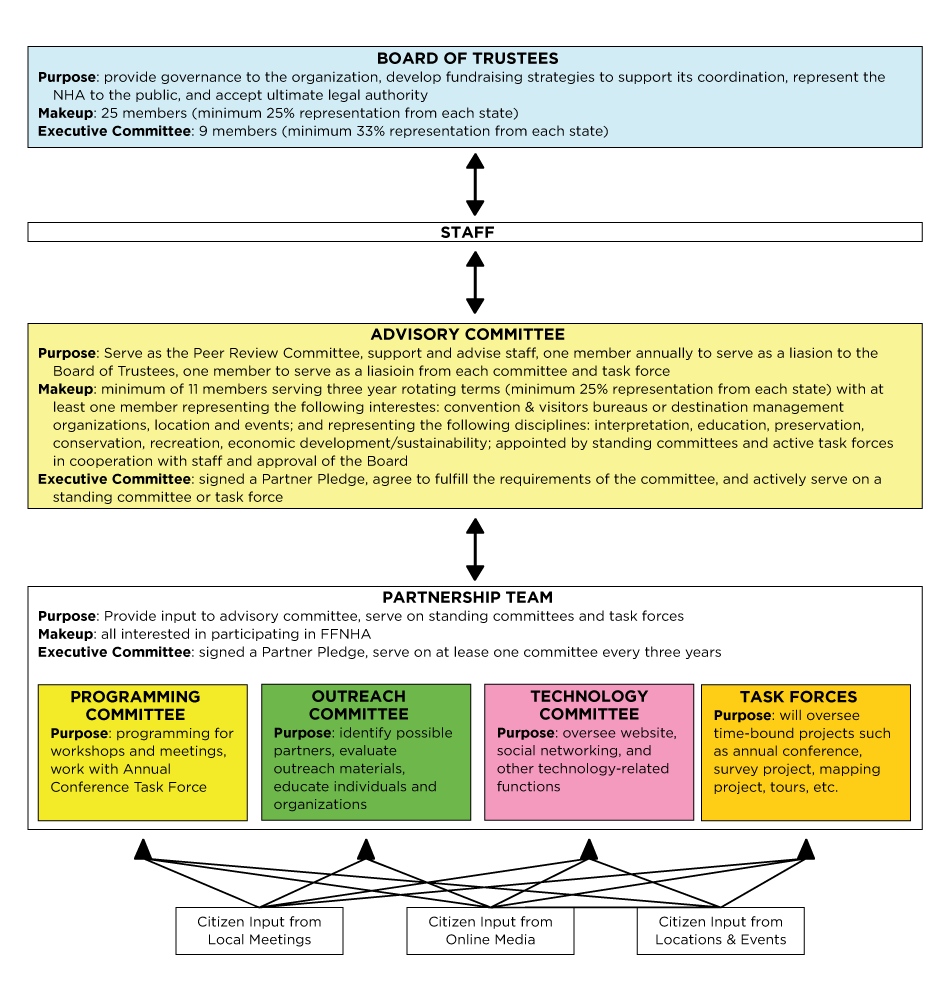
The National Heritage Area consists of willing partners from throughout the 41 counties in Missouri and Kansas who guide the planning and execution of heritage area projects. The work of FFNHA is coordinated currently by three full-time employees working with partners throughout the area. It is the only entity in the area focused on regional coordination of these nationally important stories. To uphold the integrity and purpose of the heritage area, all partners have signed a pledge stating that they will support the Freedom’s Frontier vision, mission, and guiding principles. Partners, working through task forces and committees, are represented on a bistate Board of Trustees. The board contracts with Destination Management, Inc., Lawrence, KS, to provide leadership and management.


Partner SiteCountyState
1855 Harris-Kearney House Museum and Westport Historical SocietyJacksonMOWEBSITE
1859 Jail, Marshal’s Home and MuseumJacksonMOWEBSITE
Adrian Area Historical SocietyBatesMOWEBSITE
Agency Ford MuseumBuchananMOWEBSITE
Albrecht-Kemper Museum of ArtBuchananMOWEBSITE
Alexander/Madison Chapter of KC Buffalo SoldiersJacksonMOWEBSITE
Alexander Majors House and BarnJacksonMOWEBSITE
Allen County Historical SocietyAllenKSWEBSITE
Amelia Earhart Birthplace MuseumAtchisonKSWEBSITE
Amelia Earhart Hanger MuseumAtchisonKSWEBSITE
American Flight MuseumShawneeKSWEBSITE
American Jazz MuseumJacksonMOWEBSITE
Anita B. Gorman Conservation Discovery CenterJacksonMOWEBSITE
Appleton City Landmark Restorations, Inc.St. ClairMOWEBSITE
Arabia Steamboat MuseumJacksonMOWEBSITE
Archives & Research Center of Franklin Co KSFranklinKSWEBSITE
Atchison County Historical SocietyAtchisonKSWEBSITE
Atkins-Johnson Farm & MuseumClayMOWEBSITE
Baker Wetlands and Discovery CenterDouglasKSWEBSITE
Basehor Historical Museum SocietyLeavenworthKSWEBSITE
Bates County Museum & Historical SocietyBatesMOWEBSITE
Battle of Island Mound State Historic SiteBatesMOWEBSITE
Battle of Lexington State Historic SiteLafayetteMOWEBSITE
Battle of WestportJacksonMOWEBSITE
Baxter Springs Heritage Center and MuseumCherokeeKSWEBSITE
Beecher Bible and Rifle ChurchWabaunseeKSWEBSITE
Bingham-Waggoner EstateJacksonMOWEBSITE
Black American Blueprint CollectiveShawneeKSWEBSITE
Black Archives Museum of St. JosephBuchananMOWEBSITE
Black Archives of Mid AmericaJacksonMOWEBSITE
Black Jack Battlefield and Nature ParkDouglasKSWEBSITE
Blue Room and Gem TheatreJacksonMOWEBSITE
Boston Daniels Park and CorporationWyandotteKSWEBSITE
Brown v. Board of Education National Historical ParkShawneeKSWEBSITE
Bruce R. Watkins Cultural Heritage CenterJacksonMOWEBSITE
Burlingame Historical Preservation SocietyOsageKSWEBSITE
Burlingame Schuyler MuseumOsageKSWEBSITE
Burnt District Monument and Sharps-Hopper CabinCassMOWEBSITE
Caney Valley Historical Society & MuseumMontgomeryKSWEBSITE
Carnegie BuildingDouglasKSWEBSITE
Cass County Historical Society and MuseumCassMOWEBSITE
Cave Spring Park, home of Barnes Enclosure, Cave Spring, and 3 TrailsJacksonMOWEBSITE
Cherryvale Historical MuseumMontgomeryKSWEBSITE
Civil War Round Table of Kansas CityClayMOWEBSITE
Civil War Round Table of Western MissouriJacksonMOWEBSITE
Clay County Archives & Historical LibraryClayMOWEBSITE
Clay County Historical Society MuseumClayMOWEBSITE
Clay County Historic SitesClayMOWEBSITE
Clearfield School and Historical SocietyDouglasKSWEBSITE
Clendening History of Medicine MuseumWyandotteKSWEBSITE
Coffey County Historical Society MuseumCoffeyKSWEBSITE
Concordia Area Museum and Historical SocietyJohnsonMOWEBSITE
Confederate Memorial State Historic SiteJohnsonMOWEBSITE
Constitution Hall SHS LecomptonDouglasKSWEBSITE
Constitution Hall TopekaShawneeKSWEBSITE
Crawford County Historical MuseumCrawfordKSWEBSITE
Curtis House MuseumShawneeKSWEBSITE
Democratic Headquarters of Kansas Territory in LecomptonDouglasKSWEBSITE
DeSoto Historical SocietyJohnsonKSWEBSITE
Dietrich CabinFranklinKSWEBSITE
Dole Institute of PoliticsDouglasKSWEBSITE
Dorothy Day Log Cabin at Platte Wildlife PreservePlatteMOWEBSITE
Douglas County Chapter of Santa Fe Trail Association and Ivan Boyd PrairieDouglasKSWEBSITE
Douglas County Heritage Conservation CouncilDouglasKSWEBSITE
Douglass School ProjectLafayetteMOWEBSITE
Ensor Park and MuseumJohnsonKSWEBSITE
Edgerton Community MuseumJohnsonKSWEBSITE
Ernie Miller Nature CenterJohnsonKSWEBSITE
Eudora Area Historical Society and Community MuseumDouglasKSWEBSITE
Excelsior Springs Museum and ArchivesClayMOWEBSITE
First Territorial Capitol State Historic SiteRileyKSWEBSITE
Fishburn Archives & Special Collections at Park UniversityPlatteMOWEBSITE
Flint Hills Discovery CenterRileyKSWEBSITE
Forest Grove Cemetery ProjectLafayetteMOWEBSITE
Fort Leavenworth National CemeteryLeavenworthKSWEBSITE
Fort Osage National Historic LandmarkJacksonMOWEBSITE
Fort Scott National Historic SiteBourbonKSWEBSITE
Franklin County Historical SocietyFranklinKSWEBSITE
Friends of the Free State CapitolShawneeKSWEBSITE
Frontier Army MuseumLeavenworthKSWEBSITE
Gardner Historical MuseumJohnsonKSWEBSITE
Gardner Junction ParkJohnsonKSWEBSITE
Garrison School Cultural CenterClayMOWEBSITE
Gay and Lesbian Archive of Mid-AmericaJacksonMOWEBSITE
Geary County Historical SocietyGearyKSWEBSITE
General Jo Shelby Park and StatueLafayetteMOWEBSITE
Glore Psychiatric MuseumBuchananMOWEBSITE
Goodnow House State Historic SiteRileyKSWEBSITE
Gordon Parks MuseumBourbonKSWEBSITE
Great Overland StationShawneeKSWEBSITE
Grinter Place State Historic SiteWyandotteKSWEBSITE
Guardians of Grover BarnDouglasKSWEBSITE
Harry S. Truman Birthplace State Historic SiteBartonMOWEBSITE
Harry S. Truman Farm Home in GrandviewJacksonMOWEBSITE
Harry S. Truman Library and MuseumJacksonMOWEBSITE
Harry S. Truman NHS Home Site – IndependenceJacksonMOWEBSITE
Harry S. Truman NHS Visitor CenterJacksonMOWEBSITE
Harvey J. Higgins Historical Society and Higginsville MuseumLafayetteMOWEBSITE
Haskell Cultural Center and MuseumDouglasKSWEBSITE
Historical Society of New Santa Fe and the Trailside CenterJacksonMOWEBSITE
Historic Mt. Gilead Church and SchoolClayMOWEBSITE
Historic Topeka CemeteryShawneeKSWEBSITE
Howard CemeteryJacksonMO 
Humboldt’s Orcutt Living History Backyard MuseumAllenKSWEBSITE
Humboldt Historical Society and MuseumAllenKSWEBSITE
Huron Indian CemeteryWyandotteKSWEBSITE
Independence Historical Museum and Art CenterMontgomeryKSWEBSITE
Jackson County Historical SocietyJacksonMOWEBSITE
Jefferson County Historical and Genealogical SocietyJeffersonKSWEBSITE
Jesse James Bank MuseumClayMOWEBSITE
Jesse James Birthplace Farm and MuseumClayMOWEBSITE
Jesse James Home Museum (at Patee House)BuchananMOWEBSITE
John and Mary Ritchie HouseShawneeKSWEBSITE
John Brown Museum SHS and Adair CabinMiamiKSWEBSITE
John Brown SpeaksDouglasKSWEBSITE
Johnson County Historical SocietyJohnsonMOWEBSITE
Johnson County Historic Courthouse MuseumJohnsonMOWEBSITE
Johnson County Kansas Heritage FoundationJohnsonKSWEBSITE
Johnson County LibraryJohnsonKSWEBSITE
Johnson County MuseumJohnsonKSWEBSITE
Juneteenth, KCJacksonMOWEBSITE
Kansas City Area Historic Trails AssociationJohnsonKSWEBSITE
Kansas City Kansas Community College Art GalleryWyandotteKSWEBSITE
Kansas City MuseumJacksonMOWEBSITE
Kansas Historical SocietyShawneeKSWEBSITE
Kaw Point ParkWyandotteKSWEBSITE
Kemper Museum of Contemporary ArtJacksonKSWEBSITE
King Hill Cemetery and Preservation CorpsBuchananMOWEBSITE
KU Natural History MuseumDouglasKSWEBSITE
LaBudde Special Collections, Miller Nichols Library, UMKCJacksonMOWEBSITE
La Cygne Historical SocietyLinnKSWEBSITE
Lanesfield School Historic SiteJohnsonKSWEBSITE
Lansing Historical MuseumLeavenworthKSWEBSITE
Lawrence/Douglas County Community Remembrance Project CoalitionDouglasKSWEBSITE
Lawrence Public LibraryDouglasKSWEBSITE
Leavenworth Historical Society and Carroll Mansion MuseumLeavenworthKSWEBSITE
Lecompton Historical Society And Territorial Capitol MuseumDouglasKSWEBSITE
Lee’s Summit Historical Society, Museum, and Historic CemeteryJacksonMOWEBSITE
Legler Barn Museum and DepotJohnsonKSWEBSITE
Lenexa Historical SocietyJohnsonKSWEBSITE
Leonard H. Axe Library at Pittsburg State UniversityCrawfordKSWEBSITE
Lexington Historical Association and MuseumLafayetteMOWEBSITE
Liberty African American Legacy Memorial Project at Garrison SchoolClayMOWEBSITE
Liberty Jail Historic SiteJacksonMOWEBSITE
Lied CenterDouglasKSWEBSITE
Linn County Historical Society and MuseumLinnKSWEBSITE
Little House on the Prairie MuseumMontgomeryKSWEBSITE
Lone Jack Historical SocietyJacksonMOWEBSITE
Louisburg Historical SocietyMiamiKSWEBSITE
Lowell Milken Center for Unsung HeroesBourbonKSWEBSITE
Mahaffie Stagecoach Stop and FarmJohnsonKSWEBSITE
Marais des Cygnes Massacre State Historic SiteLinnKSWEBSITE
Marais des Cygnes National Wildlife RefugeLinnKSWEBSITE
Marianna Kistler Beach Museum of ArtRileyKSWEBSITE
Marla Quilts, and African Quilts Museum, Inc.DouglasKSWEBSITE
Martha Lafite Thompson Nature SanctuaryJacksonMOWEBSITE
McClure Archives and University Museum UCMJohnsonMOWEBSITE
Mem-Erie Historical MuseumNeoshoKSWEBSITE
Merriam Historic PlazaJohnsonKSWEBSITE
Miami County Historical MuseumMiamiKSWEBSITE
Midland Railway DepotDouglasKSWEBSITE
Mine Creek Battlefield State Historic SiteLinnKSWEBSITE
Miners Hall MuseumCrawfordKSWEBSITE
Missouri River Outfitters Chapter of Sante Fe Trails AssociationJacksonMOWEBSITE
Missouri TownJacksonMOWEBSITE
Missouri Valley Room KCMO LibraryJacksonMOWEBSITE
Monticello Community Historical SocietyJohnsonKSWEBSITE
Mound City Historical Society and ParkLinnKSWEBSITE
Mount Mitchell Heritage Prairie ParkWabaunseeKSWEBSITE
Mount Mora CemeteryBuchananMOWEBSITE
Mt. Vernon Cemetery AssociationAtchisonKSWEBSITE
Museum at PrairiefireJohnsonKSWEBSITE
Museum of Deaf History, Arts & Culture, Inc (MDHAC)JohnsonKSWEBSITE
Museum of the Kansas National GuardShawneeKSWEBSITE
National Archives at Kansas CityJacksonMOWEBSITE
National Frontier Trails MuseumJacksonMOWEBSITE
National World War I Museum and MemorialJacksonMOWEBSITE
Negro Leagues Baseball MuseumJacksonMOWEBSITE
Nelson-Atkins Museum of ArtJacksonMOWEBSITE
Newell-Johnson-Searle HouseJeffersonKSWEBSITE
Olathe Historical SocietyJohnsonKSWEBSITE
Olathe Memorial CemeteryJohnsonKSWEBSITE
Olathe Public LibraryJohnsonKSWEBSITE
Old Castle Museum at Baker UniversityDouglasKSWEBSITE
Old Depot MuseumFranklinKSWEBSITE
Old Jefferson TownJeffersonKSWEBSITE
Old Prairie Town at Warde-Meade Historic SiteShawneeKSWEBSITE
Old Quindaro MuseumWyandotteKSWEBSITE
Old Stone House Along the Oregon Trail ConservancyShawneeKS 
Opothleyahola Memorial BuildingCoffeyKSWEBSITE
Oregon-California Trails AssociationJacksonMOWEBSITE
Osage County Historical SocietyOsageKSWEBSITE
Osage Mission-Neosho County Historical Society Museum and Graves LibraryNeoshoKSWEBSITE
Osage Village State Historic SiteVernonMOWEBSITE
Overland Park Arboretum and Botanical GardensJohnsonKSWEBSITE
Overland Park Historical SocietyJohnsonKSWEBSITE
Partners of the First Territorial CapitolRileyKSWEBSITE
Patee House MuseumBuchananMOWEBSITE
Pharis FarmClayMOWEBSITE
Platte County Historical Society and Ben Ferrel MuseumPlatteMOWEBSITE
Pony Express National MuseumBuchananMOWEBSITE
Poplar Heights Living History Farm and MuseumBatesMOWEBSITE
Prairie State ParkBartonMOWEBSITE
Quindaro Overlook and RuinsWyandotteKSWEBSITE
Quindaro Underground Railroad Museum (Historic Vernon School)WyandotteKSWEBSITE
Rapp SchoolOsageKSWEBSITE
Ray County Historical Society Museum and Genealogical LibraryRayMOWEBSITE
Raytown Historical Society And MuseumJacksonMOWEBSITE
Remington Nature CenterBuchananMOWEBSITE
Rice-Tremonti HomeRayMOWEBSITE
Richard Allen Cultural Center and MuseumLeavenworthKSWEBSITE
Riley County Genealogical SocietyRileyKSWEBSITE
Riley County Historical Society and MuseumRileyKSWEBSITE
Ritchie CemeteryShawneeKS 
Robidoux Row MuseumBuchananMOWEBSITE
Sauk River CampSt. ClairMO 
SEK Museum AllianceseveralKSWEBSITE
Shawnee County Historical SocietyShawneeKSWEBSITE
Shawnee Indian Mission State Historic SiteJohnsonKSWEBSITE
Shawnee Mission DAR ChapterJohnsonKSWEBSITE
Shawnee Town 1929 MuseumJohnsonKSWEBSITE
Shoal Creek Living History MuseumJacksonMOWEBSITE
Smithville MO Historical SocietyClayMOWEBSITE
Southeast KS Nature Center at Schermerhorn Park and CaveCherokeeKSWEBSITE
Spencer Museum of ArtDouglasKSWEBSITE
St. Clair County Historical Society and MuseumSt. ClairMO 
St. Joseph MuseumsBuchananMOWEBSITE
St. Philippine Duchesne Shrine and Potawatomie Trail of Death Memorial ParkLinnKSWEBSITE
Sumner Elementary School (Brown v Board Sumner Legacy Trust)ShawneeKSWEBSITE
Thomas Hart Benton Home and Studio State Historic SiteJacksonMOWEBSITE
Tonganoxie Community Historical SocietyLeavenworthKSWEBSITE
Topeka Genealogical SocietyShawneeKSWEBSITE
Trading Post MuseumLinnKSWEBSITE
Union Cemetery Historical Society and CemeteryJacksonMOWEBSITE
Union StationJacksonMOWEBSITE
Vaile Victorian MansionJacksonMOWEBSITE
Vernon County Historical Society and Bushwacker MuseumVernonMOWEBSITE
Virginia SchoolJohnsonKSWEBSITE
Wabaunsee CemeteryWabaunseeKSWEBSITE
Wabaunsee County Historical Society and MuseumWabaunseeKSWEBSITE
Wakarusa River Valley Heritage MuseumDouglasKSWEBSITE
Wakefield MuseumClayKSWEBSITE
Watkins Museum of History and Douglas County Historical SocietyDouglasKSWEBSITE
Watkins Woolen Mill State Historic SiteClayMOWEBSITE
Weaving the RiverWyandotteKSWEBSITE
Wells P. Bailey House & Historic Preservation Partnership of Lyndon, Inc.OsageKSWEBSITE
Wentworth Military Academy MuseumLafayetteMOWEBSITE
Weston Historical MuseumPlatteMOWEBSITE
Wilson County Historical Society and MuseumWilsonKSWEBSITE
Wonder Workshop Children’s MuseumRileyKSWEBSITE
Woodson County Historical Society and MuseumWoodsonKSWEBSITE
Wornall Majors House MuseumsJacksonMOWEBSITE
Wyandot Nation of KansasWyandotteKSWEBSITE
Wyandotte County Historical MuseumWyandotteKSWEBSITE
Wyandotte High School Alumni CenterWyandotteKSWEBSITE
Wyeth-Tootle MansionBuchananMOWEBSITE
County State
Allen Kansas
Anderson Kansas
Atchison Kansas
Barton Missouri
Bates Missouri
Bourbon Kansas
Buchanan Missouri
Cass Missouri
Chautauqua Kansas
Cherokee Kansas
Clay Kansas
Clay Missouri
Coffey Kansas
Crawford Kansas
Douglas Kansas
Franklin Kansas
Geary Kansas
Jackson Kansas
Jackson Missouri
Jefferson Kansas
Johnson Kansas
Johnson Missouri
Labette Kansas
Lafayette Missouri
Leavenworth Kansas
Linn Kansas
Miami Kansas
Montgomery Kansas
Neosho Kansas
Osage Kansas
Platte Missouri
Pottawatomie Kansas
Ray Missouri
Riley Kansas
Shawnee Kansas
St. Clair Missouri
Vernon Missouri
Wabaunsee Kansas
Wilson Kansas
Woodson Kansas
Wyandotte Kansas

Other Resources

Extraordinary events in the Freedom’s Frontier National Heritage Area (FFNHA) forever changed America. In the nineteenth century, the nation turned its eyes to the Missouri/Kansas border, where peoples with diverse definitions of freedom collided, inciting and fueling the Civil War. The impact of these events is forever woven into the nation’s fabric.

Shaping the Frontier: For the half million pioneers who traveled on the Santa Fe, California, Mormon, and Oregon Trials, the Missouri/Kansas border was the jumping off point. In this place where river travel ended, traders, miners, and emigrants purchased provisions and prepared for long overland treks. As they traveled west, many began to see the “permanent” Indian frontier beyond Missouri’s western border as an obstacle to Manifest Destiny.

Missouri/Kansas Border War: When Kansas was opened for settlement in 1854, a border war ensured, capturing the nation’s attention. The Kansas-Nebraska Act nullified the uneasy balance established by the Missouri Compromise and left the territory’s future slave status in the hands of settlers. The stakes were high for both sides. The violence of the Missouri/Kansas Border War ushered in the Civil War, consumed the region in bloody conflict through war’s end, and devastated communities on both sides of the border.

Enduring Struggles for Freedom: The nation’s struggle for freedom did not end with the Civil War. Though the war eliminated clashes over geography, efforts to break down society’s barriers continue. Since the Civil War, this place has inspired national policies and ongoing efforts to secure equal freedoms for all Americans.

Freedom’s Frontier provides new opportunities for visitors and residents to explore the evolving ideal and fundamental American value of FREEDOM.

Vision: Freedom’s Frontier National Heritage Area is an internationally recognized region in western Missouri and eastern Kansas. The heritage area shares its authentic and honestly interpreted stories with residents and visitors who add to the economic vitality of the region. Freedom’s Frontier respects multiple views of freedom and promotes the region’s contributions to the American story.

Mission: We tell the stories of the struggles for freedom in our region and their lasting impact on our nation.

Guiding Principles:
1. We will be tolerant and respectful diverse stories from multiple perspectives.
2. We will respect property rights.
3. We will focus on authentic and engaging experiences.
4. We honor the region’s peoples, past and present.
5. We appreciate unique cultural and historic assets within the nationally important landscape.
6. We will invest in community engagement, education, and empowerment.
7. We will sustain and grow a sense of place.
8. We value and protect the natural environment.
9. We will consider future generations in all actions.

Prior to its designation as a National Heritage Area, FFNHA completed a feasibility study. It was submitted to Congress in 2006.

Read FFNHA’s feasibility study.

FFNHA was designated by Congress as a National Heritage Area on October 12, 2006.

View our enabling legislation here.

National Heritage Area legislation typically requires the development of a management plan within three years of designation. National Heritage Area management plans include long-range policies, goals, strategies, and actions; an implementation plan with short, mid, and long-range actions and performance goals; a business plan for the heritage area coordinating entity; and an interpretive plan.

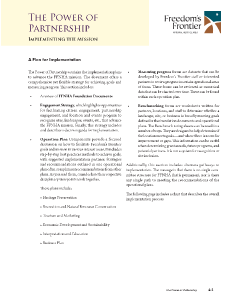
For readability and user convenience, the FFNHA Management Plan is separated into sections below. For a complete PDF, please contact info@freedomsfrontier.org.


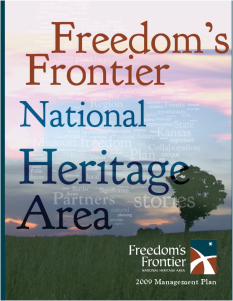
I. Front Cover & Table of Contents


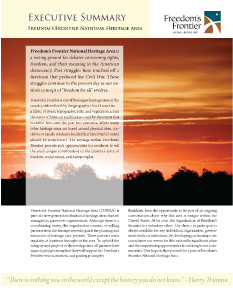
II. Executive Summary


III. Part 1: The Power of Place


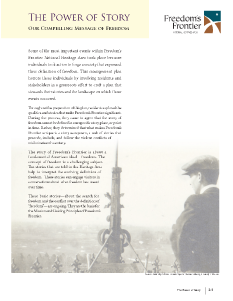
IV. Part 2: The Power of Story


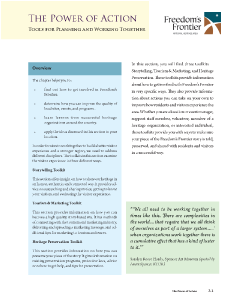
V. Part 3: The Power of Action


VI. Part 4: The Power of Partnership


VII. Part 5: The Power of People


VIII. Appendix A


IX. Appendix B

The maps below appear in the FFNHA Management Plan.


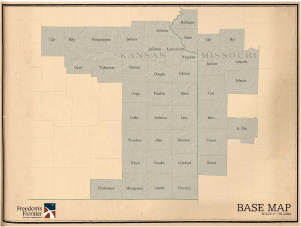
Counties of Freedom’s Frontier
A map of Freedom’s Frontier NHA’s boundaries


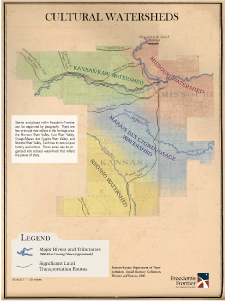
Cultural Watersheds
A map of the four principal river valleys within FFNHA’s boundaries


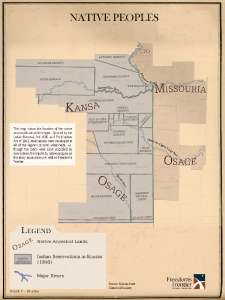
Native Peoples
A map of native ancestral lands within FFNHA


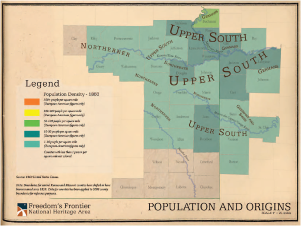
Population and Origins 1860
A map of FFNHA measuring population density of European-American settlers circa 1860


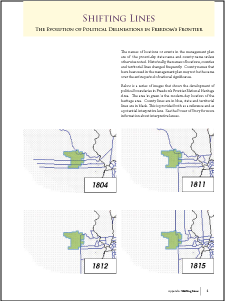
Shifting Political Boundaries
A series of maps demonstrating shifts in the political geography of counties within FFNHA since 1804


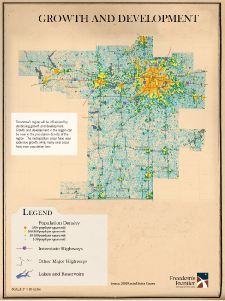
Growth and Development
A map measuring contemporary population density within FFNHA’s boundaries


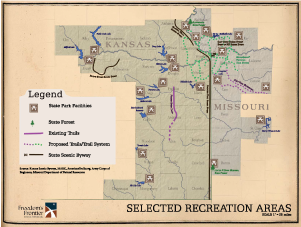
Recreation Resources
A map indicating the locations of state parks, state forests, trails, and state scenic byways within FFNHA


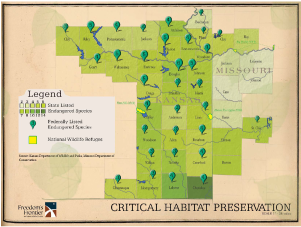
Critical Habitat
A map measuring the density of endangered species recognized by state and federal agencies, along with the locations of national wildlife refuges, within FFNHA

Over the past 30 years, Congress has established 62 National Heritage Areas (NHAs) to commemorate, conserve, and promote important areas that include natural, scenic, historic, cultural, and recreational resources. NHAs are partnerships between the National Park Service (NPS), states, and local communities, where the NPS supports state and local conservation through federal recognition, seed money, and technical assistance. NHAs are not part of the National Park System, where lands are federally owned and managed. Rather, lands within heritage areas typically remain in state, local, or private ownership. In addition, other heritage areas have been designated by states and local governments and announcements. This issue brief, prepared by the Congressional Research Service, focuses on heritage areas designated by Congress, and related issues and legislation.

Learn more.

“In the life of a civilization, there are stories that must be preserved for generations to come. One of these stories has taken place right here along the Missouri/Kansas border. At its heart, ours is a story of the conflict we face as we struggle to define freedom for ourselves. This nation was created in the name of freedom for its people, but that labor for liberty was never more graphically played out as it was along the Missouri/Kansas border near the time of the Civil War. Freedom’s Frontier National Heritage Area will tell this story. We will show the world that out of border wars comes human understanding; out of bloodshed, serious introspection; and out of irreconcilable conflict, reconciliation. Extraordinary events in the Freedom’s Frontier National Heritage area forever changed America. Settlers heading westward clashed with Native Americans and their way of life. Women’s issues and the temperance movement became issues of their day. More recently, the enduring struggle for freedom played out here as African Americans sought equal educational opportunities for their children. While other Heritage Areas may define themselves by physical sites and geographic markers, Freedom’s Frontier National Heritage Area is based on the stories that unfolded here. We hope everyone, in this country and around the world, will join us in our effort to make Freedom’s Frontier a place to use the old stories of the border to inspire us to tear down borders all around this globe – and those we are yet to encounter – in the ever-important goal of enhancing human tolerance and understanding.”

– Deanell Reece Tacha, Founding Chair of the Board of Trustees

Freedom’s Frontier National Heritage Area consists of partners working together to tell the stories of pursuits for freedom. We provide opportunities to explore the questions posed by our very name and the evolving ideal and fundamental American value of freedom.

Questions to be pondered:
Whose FREEDOMS are important?
How is the FRONTIER determined?
Are local and NATIONAL politics inseparable?
Whose HERITAGE are we preserving?
Is this AREA free?

Freedom’s Frontier National Heritage Area, a 501c3, works from a Cooperative Agreement with the National Park Service and a required Management Plan approved by the Secretary of the Interior in 2010. These documents provide guidance for this work. Several hundred residents came together in a public process over a period of two years to create the Management Plan including the following foundation documents: Vision and Mission, Statement of National Significance, Major Theme and Subthemes, Guiding Principles, Location and Event Application, Property Owner Letter of Agreement and Partner Pledge.

National Heritage Areas are designated by the United States Congress to promote historic preservation, appreciation, and understanding. In 2006 Congress authorized and the President signed into law, a measure that created Freedom’s Frontier National Heritage Area, a 31,000 square-mile region in eastern Kansas and western Missouri which the Santa Fe, Oregon, California and Mormon historic trails west traversed.

Freedom’s Frontier National Heritage Area consists of partners working together to tell the stories of pursuits for freedom. We provide opportunities to explore the questions posed by our very name and the evolving ideal and fundamental American value of freedom.

Questions to be pondered:
Whose FREEDOMS are important?
How is the FRONTIER determined?
Are local and NATIONAL politics inseparable?
Whose HERITAGE are we preserving?
Is this AREA free?

Freedom’s Frontier National Heritage Area, a 501c3, works from a Cooperative Agreement with the National Park Service and a required Management Plan approved by the Secretary of the Interior in 2010. These documents provide guidance for this work. Several hundred residents came together in a public process over a period of two years to create the Management Plan including the following foundation documents: Vision and Mission, Statement of National Significance, Major Theme and Subthemes, Guiding Principles, Location and Event Application, Property Owner Letter of Agreement and Partner Pledge.

ABOUT FREEDOM'S FRONTIER

“In the life of a civilization, there are stories that must be preserved for generations to come. One of these stories has taken place right here along the Missouri/Kansas border. At its heart, ours is a story of the conflict we face as we struggle to define freedom for ourselves. This nation was created in the name of freedom for its people, but that labor for liberty was never more graphically played out as it was along the Missouri/Kansas border near the time of the Civil War. Freedom’s Frontier National Heritage Area will tell this story. We will show the world that out of border wars comes human understanding; out of bloodshed, serious introspection; and out of irreconcilable conflict, reconciliation. Extraordinary events in the Freedom’s Frontier National Heritage area forever changed America. Settlers heading westward clashed with Native Americans and their way of life. Women’s issues and the temperance movement became issues of their day. More recently, the enduring struggle for freedom played out here as African Americans sought equal educational opportunities for their children. While other Heritage Areas may define themselves by physical sites and geographic markers, Freedom’s Frontier National Heritage Area is based on the stories that unfolded here. We hope everyone, in this country and around the world, will join us in our effort to make Freedom’s Frontier a place to use the old stories of the border to inspire us to tear down borders all around this globe – and those we are yet to encounter – in the ever-important goal of enhancing human tolerance and understanding.”
– Deanell Reece Tacha, Founding Chair of the Board of Trustees

National Heritage Areas are designated by the United States Congress to promote historic preservation, appreciation, and understanding. In 2006 Congress authorized and the President signed into law, a measure that created Freedom’s Frontier National Heritage Area, a 31,000 square-mile region in eastern Kansas and western Missouri which the Santa Fe, Oregon, California and Mormon historic trails west traversed.

Mission

Freedom’s Frontier National Heritage Area (FFNHA) is dedicated to building awareness of the struggles for freedom in western Missouri and eastern Kansas. These diverse, interwoven, and nationally important stories grew from a unique physical and cultural landscape. FFNHA inspires respect for multiple perspectives and empowers residents to preserve and share these stories. We achieve our goals through interpretation, preservation, conservation, and education for all residents and visitors.

Measuring Success

Benchmarks are included in a work plan that is submitted annually to the National Park Service to access authorized federal funding. The work plan must also tie directly to the FFNHA enabling legislation. Measures of success include:

  • Increased awareness and understanding of the heritage area throughout the region and nation.
  • Increased visitation to FFNHA partner sites.
  • Widespread dissemination of FFNHA information using a variety of media platforms.
  • Leverage of funds supporting partner member site improvements and programming efforts.
  • Development of a distinctive and recognized visual identity, through coordination of literature, signage, and other branding efforts.
  • Incorporation of FFNHA themes into educational curricula throughout the region, both in K-12 and higher education institutions.

Goals with Achievements to Date

Goal 1. Build awareness and identity for the region based on stories of the struggles for freedom that took place within the boundaries of Freedom’s Frontier NHA.

  • 1a. We will share stories and messages about freedom through a dialogue with a wide range of audiences. Communication tools will be tailored to the needs of each audience.

To Date:

  • Produced a 12-minute video DVD to use in presentations and on the FFNHA website, with a grant from the Barton P. & Mary D. Cohen Charitable Trust.
  • Produced a comprehensive map depicting the heritage area’s history and printed 150,000 copies, with the support of the William T. Kemper Foundation.
  • Made 74 presentations (as of September 2011) reaching nearly 2,500 residents in more than 50 communities to gain support for the work of FFNHA.
  • Partnered with Symphony in the Flint Hills to commemorate the Sesquicentennial of Statehood and the beginning of the Civil War and to raise awareness of FFNHA for the audience of 7,000+, on June 10, 2011. The FFNHA message was communicated in early promotional materials, in the event program/field journal and in a speakers’ tent the day of the event.

  • 1b. We will maintain online tools to engage residents in learning about Freedom’s Frontier stories and the values they teach.

To Date:

  • Established a social media strategy, integrating Facebook, Twitter, and a blog to present FFNHA messages.
  • Work made possible by a grant from the Douglas County Community Foundation and KU Museum Studies interns is nearly complete on a prototype to use in conjunction with QR codes that will allow visitors to access additional information on sites from their smart phones. The goal is to enhance existing exhibits and to assist partners in connecting their stories to one another.

Goal 2. Enhance, sustain, and preserve the unique cultural and historic assets within our physical and cultural landscapes that fostered these stories.

  • 2a. We will work with site owners and managers, event managers, collections managers, craftspeople and artists, local historians, state, county and local agencies and other interested partners to identify the unique historic, cultural and natural resources, and stories within the heritage area that contribute to the Freedom’s Frontier story.

To Date:

  • Presented educational workshops to nearly 1,000 partners at 19 regular meetings of FFNHA partners.
  • Successfully wrote a $55,000 grant to the American Battlefield Protection Program to create a strategic plan for the Lone Jack Battlefield. FFNHA staff will manage the grant.

  • 2b. We will inform individuals, organizations, and government entities about the heritage area in order to encourage them to sustain a sense of place through preservation and conservation.

To Date:

  • The Douglas County Commission has adopted $350,000 for a Cultural and Heritage Grant Fund that incorporates FFNHA themes in the scope of the application. As part of the project, the county will become a prototype for partner counties in CLG application and survey of heritage sites.

  • 2c. We will work with regional groups to protect key historic and ecological sites that support the heritage area’s stories.

To Date:

  • Freedom’s Frontier has established a relationship with Mid-America Regional Council (MARC), Missouri & Kansas Scenic Byways Commissions, Missouri Department of Natural Resources, Kansas State Historical Society, Kansas Land Trust, environmental advocacy groups, state government agencies such as MoDOT and KDOT, Fort Leavenworth and numerous city and county governments.

Goal 3. Inspire tolerance and respect for multiple perspectives.

  • 3a. We will work with local educators and educational institutions to develop, promote, and offer educational opportunities to increase awareness of the Freedom’s Frontier stories in the heritage area’s schools and provide programming for the general public.

To Date:

  • Supported an NPS grant for Historic Fort Scott’s production of 500 DVDs to be distributed to middle schools in the area.
  • Offered a financial award to 2009 and 2010 Kansas History Day winners who choose topics related to FFNHA themes.
  • Sponsored the Kansas Humanities Council program “Shared Stories of the Civil War” offering primary-sourced scripts and facilitation guidance focused on the history of the area for Reader’s Theatre productions that depict both Missouri and Kansas perspectives on the topics. To date 3,187 people have accessed the information from the KHC website and a recent video production of an event has been viewed 67 times in the first month available. The program is expected to gain momentum over the fall and winter.

  • 3b. We will reach out to underserved communities both as a key audience and for input in the planning and execution of projects.

To Date:

  • Exhibited at the National Network to Freedom Conference, the Votaw Colony Reunion Conference and met with numerous African American and Native American groups to explore ways to work together.

  • 3c. We will work with partners such as colleges, universities, and institutes to support conferences and public forums to discuss and debate the regional and global meaning of freedom from various perspectives.

To Date:

  • In partnership with the Kansas City Public Library, will sponsor the Border War Conference, scheduled for November 10-12, 2011. Twelve scholars from throughout the country will present papers and engage the public around new perspectives on the Border War.

Goal 4. Empower residents to preserve and share our nationally important authentic stories in an engaging way.

  • 4a. We will work with site owners and managers and event organizers to recognize locations and events and to improve the visitor experience and interpretation as well as to help them meet criteria that will allow them to become recognized locations and events.

To Date:

  • Worked with 50+ sites to submit information and have peer reviews conducted to qualify for levels of recognition and appearance on the historic map.

  • 4b. We will work with our recognized locations and events to enhance services, interpretation, and connection to the Freedom’s Frontier story and to other sites in the heritage area.
  • 4c. We will continue to engage residents in planning and executing projects to increase awareness and support of Freedom’s Frontier by local constituents.

Goal 5. Work with individuals, economic development organizations, tourism bureaus, and government entities to develop Freedom’s Frontier as a sustainable destination.

  • 5a. We will work with individual destinations, sites, and tourism marketing entities to promote Freedom’s Frontier in a coordinated way.

To Date:

  • Developed a cooperative advertising concept for partners and placed in the Missouri and Kansas Travel Guides for 2011-12 (distribution of nearly 1 million) as well as in three special sections of the Kansas City Star on the Civil War.
  • A comprehensive historical map of the area is distributed through partners, tourism visitor centers, and in response to requests for information.

  • 5b. We will encourage and promote annual events tied to significant anniversaries of Freedom’s Frontier stories.

To Date:

  • Annual events appear on the comprehensive historical map and on each state’s tourism calendar.
  • Participated in 24 outreach events in 17 communities using an outreach display of photos and the distribution of the comprehensive historical map. Sponsored a historic performance tent at the Kansas Sampler Festival.
  • Partnered with Symphony in the Flint Hills to commemorate the Sesquicentennial of Statehood and the beginning of the Civil War and to raise awareness of FFNHA to the audience of 7,000+, on June 10, 2011. The FFNHA message was communicated in early promotional materials, in the event program field journal and in a speaker’s tent on the day of the event.

Funding

Enabling legislation authorizes basic operating funds. These federal funds must be matched 1:1 by local dollars. FFNHA has received funding from the following private and public foundations, governments and private individuals to match federal dollars and support this work: City of Lawrence, KS; Douglas County KS Board of Commissioners; Lawrence, KS Convention & Visitors Bureau; Missouri Division of Tourism; Kansas Department of Wildlife, Parks & Tourism; Barton P. and Mary D. Cohen Charitable Trust, William T. Kemper Foundation, Monarch Cement Company (Humboldt, KS); Mid-America Regional Council (MARC); Capitol Federal Foundation; South East Kansas Prosperity Foundation; Kansas Humanities Council; Charles & Virginia Clark Fund of the Greater Kansas City Community Foundation; Kansas Health Foundation, Breidenthal Foundation, KCK; New Dymax, Inc., Wamego, KS; Central National Bank, Junction City, KS; and more than 25 other governments, individuals and organizations.

Organization

The National Heritage Area consists of willing partners from throughout the 41 counties in Missouri and Kansas who guide the planning and execution of heritage area projects. The work of FFNHA is coordinated currently by three full-time employees working with partners throughout the area. It is the only entity in the area focused on regional coordination of these nationally important stories. To uphold the integrity and purpose of the heritage area, all partners have signed a pledge stating that they will support the Freedom’s Frontier vision, mission, and guiding principles. Partners, working through task forces and committees, are represented on a bistate Board of Trustees. The board contracts with Destination Management, Inc., Lawrence, KS, to provide leadership and management.

Freedom’s Frontier National Heritage Area consists of partners working together to tell the stories of pursuits for freedom. We provide opportunities to explore the questions posed by our very name and the evolving ideal and fundamental American value of freedom.

Questions to be pondered:
Whose FREEDOMS are important?
How is the FRONTIER determined?
Are local and NATIONAL politics inseparable?
Whose HERITAGE are we preserving?
Is this AREA free?

Freedom’s Frontier National Heritage Area, a 501c3, works from a Cooperative Agreement with the National Park Service and a required Management Plan approved by the Secretary of the Interior in 2010. These documents provide guidance for this work. Several hundred residents came together in a public process over a period of two years to create the Management Plan including the following foundation documents: Vision and Mission, Statement of National Significance, Major Theme and Subthemes, Guiding Principles, Location and Event Application, Property Owner Letter of Agreement and Partner Pledge.